

The pilot activities implemented within VANGUARD are grounded in a comprehensive, structured methodological framework that supports consistent planning, controlled execution, and systematic evaluation. This framework provides the foundation for all pilot activities, ensuring alignment with operational realities, end-user needs, and the project’s broader objectives.
Rather than approaching pilot activities as isolated demonstrations, the methodology treats them as part of an integrated lifecycle. Preparation, execution, and evaluation are considered interdependent phases, each informing and reinforcing the others. This phased structure supports methodological coherence and enables the design and implementation of pilot activities in a repeatable, comparable manner across different contexts and use cases.
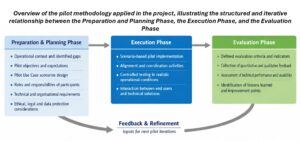
Preparation and Planning Phase
The preparation and planning phase represents the cornerstone of the pilot methodology. It focuses on establishing a clear understanding of the operational context for each pilot. This includes identifying existing practices, infrastructure conditions, organisational constraints, and operational gaps. Based on this contextual analysis, clear objectives and expectations are defined for each pilot activity. These objectives are then translated into concrete, scenario-based designs that reflect realistic operational conditions rather than abstract or ideal settings.
During preparation, particular methodological emphasis is placed on the structured definition of roles and responsibilities. Pilot leaders, participants, technical contributors, and supporting actors are clearly identified, and their involvement is aligned with the objectives and scope of the pilot activities. In parallel, technical and organisational requirements are identified, including infrastructure needs, system configurations, and resource planning. This structured approach ensures that all necessary prerequisites are addressed before pilot execution begins.
Ethical, legal, and data protection considerations are also integrated into the preparation phase as core methodological elements. Rather than being treated as external constraints, these aspects are embedded within pilot design to ensure compliance, transparency, and responsible engagement. Issues related to personal data processing, informed participation, and legal safeguards are systematically considered, contributing to the overall robustness and legitimacy of the pilot activities.
Execution Phase
Building on this preparatory groundwork, the execution phase applies the methodology in practice. Pilot activities are conducted using predefined scenarios that simulate real operational conditions. These scenarios provide a controlled yet realistic environment for testing tools, workflows, and interactions. The methodological framework ensures that execution follows a clearly defined flow, allowing activities to be carried out consistently while still accommodating contextual variations across pilot sites.
Coordination and alignment activities are integral to execution. Preparatory meetings and test activities support a shared understanding of pilot objectives, scenarios, and execution steps among participants. These activities help ensure that the pilot unfolds as designed and that deviations are minimised or addressed in a controlled manner. The emphasis during execution remains on methodological fidelity, ensuring that observed outcomes can be meaningfully interpreted in relation to the original objectives.
Evaluation Phase
Evaluation is embedded in the methodology from the outset and treated as a continuous, structured process. Evaluation criteria, indicators, and data collection tools are defined during the preparation phase and applied throughout execution. This enables the systematic collection of both quantitative and qualitative input, covering technical performance, usability, operational relevance, and user experience.
Integrating qualitative feedback with structured evaluation metrics enables the methodology to capture contextual insights that would otherwise be difficult to identify. Participant observations, reflections, and experiences complement measurable indicators, supporting a more comprehensive assessment of pilot outcomes. Evaluation results are not treated as an endpoint, but as inputs that inform refinement, adjustment, and learning across pilot iterations.
Cross-cutting Principles
Across all phases, ethical, legal, and social considerations function as cross-cutting methodological principles. Attention to data protection, transparency, accountability, and respect for participants remains constant throughout the planning, execution, and evaluation phases. This approach reflects the project’s commitment to responsible innovation and ensures that pilot activities are conducted in line with European values and regulatory frameworks, particularly given the sensitive operational domains addressed.
Overall, the pilot methodology provides a structured, scalable, and evidence-based framework for testing solutions in realistic conditions. By aligning preparation, execution, and evaluation within a single methodological approach, the pilot activities support reliable learning and comparative assessment across diverse contexts. This methodology-driven approach ensures that pilot outcomes are not only technically informative but also operationally meaningful and methodologically sound, contributing to results that can be responsibly transferred and applied beyond the project’s lifetime.