

Human trafficking is a hidden, fast-moving crime that exploits vulnerable people and often crosses borders. Identifying and protecting victims depends on piecing together small, easily overlooked signs, such as a brief appearance on a camera, repeated movement through the same locations, or sudden changes in behaviour. Through the EU-funded VANGUARD project, ATOS IT is transforming advanced yet practical detection tools into real-world capabilities, helping law enforcement and victim support organisations move more quickly, clearly, and confidently from information to action.
Why human detection and re‑identification matter?
Human detection starts with a simple question: “Is there a person in this image?” Re‑identification, or “re‑ID”, takes it a step further: “Is the person seen here the same one seen over there?” Together, these technologies turn large volumes of visual data, from CCTV, transit cameras, and other visual sources, into actionable leads. For investigators, that means fewer hours of manual review, earlier interventions, and better decisions about where to focus limited resources to protect people at risk.
Methodological and Technical Innovations
Our approach to human detection and re-identification is built around the integration of lightweight AI-based models for real-time person detection and tracking. These models continuously analyse video streams to identify individuals and monitor their movements across frames. In particular, we apply advanced feature-extraction models that generate robust visual signatures, such as clothing patterns, body shape, and gait, enabling reliable cross-camera matching without relying on any personal identifiers.
To further strengthen performance, we leverage generative AI to create cross-domain datasets that capture a wide range of environments and visual conditions. This enhances the adaptability and accuracy of our models, ensuring they perform effectively across diverse operational contexts.

.
Together, these methodological advances make our system both efficient and insightful, providing investigators with timely and actionable intelligence to help detect and prevent trafficking in human beings.
Core components of the toolkit
The detection and re‑identification toolkit bring several key elements together into an operational workflow:
- Person detection and tracking: Lightweight AI models analyse video streams in real time, assigning identifiers to persons and following their movements across frames. This first step converts raw pixels into potential events that merit attention.
- Feature extraction for re‑ID: Advanced algorithms then generate distinctive visual “signatures” for each person, capturing elements like clothing patterns or body shape, which can be matched across cameras (video feeds). These signatures are designed to be resilient to changes in viewpoint, lighting, and partial occlusions.
- Cross‑camera matching and ranking: The Re‑ID engines compare these visual signatures across video feeds and provide ranked lists of possible matches with confidence scores, helping analysts focus on the most promising links first.
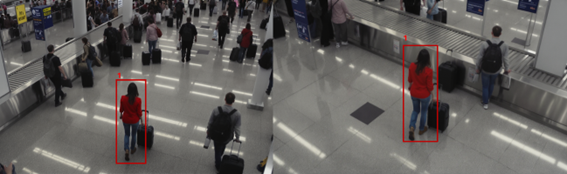
Enabling Faster Identification and Protection in Human Trafficking Cases
With this person re-identification module in place, efforts to combat human trafficking can move faster and more decisively from detection to protection. By automatically linking sightings across locations, the system helps uncover movement patterns that are often invisible in trafficking cases, enabling earlier victim identification and faster intervention when time is critical. Confidence-ranked leads make it possible to prioritise the most likely trafficking scenarios, ensuring limited resources are directed toward cases where victims are at greatest risk and support can have the most immediate impact.
Next steps
Our work within VANGUARD continues to evolve, with current priorities focused on:
- Continuous improvement on robustness and bias mitigation through the use of appropriate datasets and generative AI‑based augmentation.
- Expanding pilot testing to validate performance in real-world operational scenarios.
- Developing text- and image‑based search capabilities to support targeted investigations.