

The timely and effective analysis of large volumes of heterogeneous data, and their translation into actionable, operational decisions, is invaluable for security practitioners combating Trafficking in Human Beings (THB). Online environments, including web and social media platforms, and physical border checkpoints generate vast amounts of information that can support investigations, provided that this information is processed, correlated, and presented in an accessible and operationally relevant way. The VANGUARD project addresses this challenge by developing an advanced and user-friendly solution to strengthen the operational capabilities of police and border guard authorities.
At the heart of the project lies the VANGUARD ToolSuite, validated through a series of Pilot Use Cases (PUCs) that reflect real operational scenarios, spanning the detection, identification, investigation and prevention of both online and border-related THB activities. These pilot activities play a crucial role in the project: they define concrete operational scenarios, user workflows, and decisions that the ToolSuite must support. Rather than serving as abstract demonstrations, the PUCs simulate realistic investigative and operational processes encountered by police and border guard authorities.
Inside VANGUARD ToolSuite: How it Supports THB Detection, Identification, Investigation and Prevention
The VANGUARD ToolSuite is a scalable suite of tools that combines advanced sensors with innovative AI-based methods to support the analysis of content obtained from a wide range of heterogeneous sources, enabling the detection, investigation, assessment, and prevention of potential THB incidents. These sources span both the online space, such as websites and social media platforms, and physical environments at border control points supported by visual inputs from diverse camera systems.
The application concept is built around a clear understanding of the operational tasks the system is designed to support and the relationships between tools, sensors, and the user interface. Users retain direct control over selected tools, including the crawler, thermal cameras, CCTV cameras, and Terahertz (THz) scanner, while other components of the ToolSuite (including multimedia and multilingual content analysis, pattern recognition and correlation, risk assessment, and predictive analytics) operate seamlessly in the background. Through the user interface, practitioners can launch specific tools, access and visualise data and results in real or near-real-time, and review outcomes generated automatically by background analytical services, ensuring effective operational support without adding unnecessary complexity.
Where Technology Meets the User: ITTI’s Interface for VANGUARD
The design and development of the front-end and graphical user interface (GUI) of the VANGUARD ToolSuite are led by ITTI, a small and medium-sized enterprise founded in 1996 and based in Poznań, Poland. With around 75 employees, ITTI operates as a software house and technological company delivering customised software solutions in three main areas: (i) R&D projects focused on technology demonstrators and prototypes; (ii) software for the space sector, primarily for the European Space Agency; and (iii) dedicated IT applications for commercial and public sector clients.
Within the VANGUARD project, ITTI’s role focuses on ensuring that the ToolSuite’s analytical and AI-driven capabilities are presented to end-users through an intuitive, responsive, and operationally meaningful web application. Overall, the front-end serves as the primary interface between security practitioners and the underlying analytical systems, enabling usability, situational awareness, and overall effectiveness during operations.
Turning Research into Reality: Designing the VANGUARD ToolSuite Interface
In the initial phase, ITTI conducted research into state-of-the-art visualisation and web technologies, working closely with the project’s technical partners to ensure architectural alignment. Through this collaboration, the project adopted reliable, widely used and supported technologies for developing dynamic, maintainable web applications. The selected technology stack established a solid foundation for scalability, long-term sustainability, and seamless integration with backend services.
Drawing directly from the defined pilot use cases, ITTI designed a series of mock-ups illustrating both the appearance and functionality of the VANGUARD ToolSuite. These mock-ups were conceived not as static design artefacts but as dynamic representations of real user workflows. The first design elements were presented at several project meetings, where feedback from both end-user and technical partners provided valuable insights. Combining this input with an analysis of use case sequence diagrams, ITTI expanded the mock-ups with additional functionalities and developed the first clickable prototype. This iterative, user-driven approach ensured a highly targeted solution that reduced rework, accelerated development, and significantly lowered the overall cost of delivering a robust, user-ready interface.
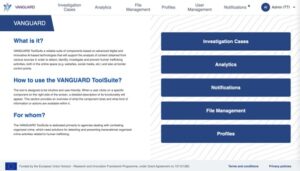
Fig. 1. Landing page of the VANGUARD ToolSuite: an intuitive interface enabling seamless navigation across application modules.
Pilot Use Cases as the Backbone of VANGUARD ToolSuite Design
Pilot Use Cases (PUCs) play a crucial role in the VANGUARD project, not only by guiding validation but also by fundamentally shaping the design of the system’s architecture and functionalities. They define how the ToolSuite is used in practice, what information is required at each stage of an investigation, and how results should be presented to support decision-making. In this sense, PUCs act as a bridge between advanced technology and real-world operations.
PUC1: Turning Online Clues into Investigative Insights
At the current stage of the project, the VANGUARD ToolSuite supports PUC1 focusing on web and social media platforms. It helps investigators turn online clues into actionable insights by identifying websites and social media channels used for THB recruitment and exploitation and by crawling and analysing multimedia content (inducing text, visual, and audio). The system supports the extraction of entities and concepts of interest, the identification of indicators of interest (such as tattoos or birthmarks), the pattern recognition and correlation, and the assessment of risks related to potential THB activities. Results are presented to users through dashboards and alerts, including visualisations of trends over time and predictions of possible future actions based on historical patterns.
PUC2: Empowering Decisions at the Border
In parallel with the execution of PUC1, the VANGUARD ToolSuite has also been extended to support PUC2, which has already been partially demonstrated and validated. The objective of PUC2 is to support police and border guard authorities in their decision-making at physical checkpoints, enabling the early identification of patterns related to potential victims and perpetrators and contributing to the disruption of trafficking chains.
For this pilot, the ToolSuite brings together data from surveillance, thermal, and terahertz imaging cameras to provide enhanced situational awareness at the border. It enables face recognition, human detection and re-identification, emotion analysis based on facial expressions and body posture, including face emotion recognition, thermal face emotion recognition, and body posture emotion recognition, and the detection of human presence in cargo. Ongoing front-end development ensures that these capabilities are consistently integrated within the same coherent interface as PUC1, allowing practitioners to operate seamlessly across both online and physical environments without fragmenting the user experience.
From Design to Implementation and Future Exploitation
The development of the VANGUARD ToolSuite front-end progressed hand in hand with backend integration, with particular attention to the reliable retrieval and validation of available API endpoints and to ensuring smooth, robust communication between the front-end and backend layers. Architecturally, the ToolSuite is designed around a microservices-based approach with event-driven elements in the backend, ensuring scalability, resilience, and technological flexibility. This design enables individual services to be developed, deployed, and evolved independently, reduces the risk that a single-component failure will affect the entire system, and allows the use of the most appropriate technologies for each service. From an exploitation perspective, this architectural approach – combined with the use of widely adopted technologies – provides a strong foundation for future extensions, enabling the VANGUARD ToolSuite to be adapted to additional operational scenarios, enriched with new analytical capabilities, and deployed in broader contexts beyond the current pilot use cases.
The Road Ahead: Iterating and Expanding the VANGUARD ToolSuite
Looking ahead, the next phase of the project will focus on further refining and extending the VANGUARD ToolSuite through iterative development cycles closely aligned with the Pilot Use Cases. Particular emphasis will be placed on continuously improving the user interface based on feedback gathered during successive PUC iterations, ensuring that the system remains fully aligned with real operational needs.
At the same time, development efforts will concentrate on expanding the ToolSuite’s capabilities to better support both existing and emerging requirements of the pilot scenarios. This includes enhancing existing functionalities, integrating additional tools and data sources, and ensuring seamless interaction between system components.
This iterative, pilot-driven approach will enable the VANGUARD ToolSuite to progressively mature into a robust and user-oriented solution. The upcoming stages of development, including more detailed insights into how the ToolSuite evolves to meet PUC requirements, will be presented in greater detail in our next blogpost.